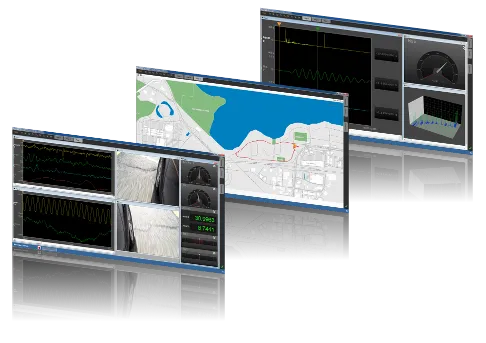
Nighthawk integrates seamlessly with Hi-Techniques' Aspire software, which supports the
company's complete DAQ range. Aspire is designed as an out-of-the-box platform for setup,
display, and analysis from sensor to solution.
Aspire automatically discovers local and networked Hi-Techniques products and configures itself
to match hardware capabilities. IPv6 support eliminates the need to set
individual
TCP/IP addresses: connect a network cable and available DAQ systems are discovered
automatically.
Software updates are available free of charge from the Hi-Techniques website. Aspire can operate
while connected to a DAQ system or offline for pre-test setup and post-test analysis.
Scalable Setup and Configuration
- Setup Wizard: Guides new users through channel setup and sensor settings.
Enter values from a sensor datasheet or calibrate single/multiple sensors through the
wizard.
- Spreadsheet Setup: Supports rapid configuration in large-channel-count
systems.
- Group Operations: Group similar sensors for group setup, such as balancing
100 strain gages with a single keystroke.
- Extend-Select: Control and adjust multiple sensors in one unified action.
Viewing Data
Aspire supports multiple display types for different data sources: scrolling strip charts,
fast-refreshing oscilloscope displays, video displays, spectral displays, meter displays, and
numeric displays. Workspaces can mix display types across multiple windows, pages, and monitors.
- Analog sensor signals & CAN-bus data
- Digital inputs, including frequency and RPM
- Video data & quadrature / rotational data
- GPS data, including speed, position, and altitude
- Numeric displays with selectable meter styles and cursor synchronization across pages
ATE and Control Applications
For system-level or control applications, Nighthawk provides access to real-time data directly
from hardware without potential software latencies. Data can stream at full sample rates over
high-speed 2.5GbE Ethernet to Linux, Windows, or other real-time hosts. An Application
Programming Interface (API) supports integration into system-level applications and
automated-test
environments.
Data Analysis and Export
Built-in interactive analysis includes more than 100 math functions (trigonometry, calculus,
timing, and spectral). The Waveform Calculator calculates on-screen statistics such as maximum,
minimum, RMS, and frequency at the touch of an icon. An integrated Formula Editor supports
combining functions for custom real-time calculations. For repetitive tasks and automation,
Nighthawk embeds the open-source Python language and a remote command set.
Integrated Sensor Database
Aspire's Sensor Database maintains complete sensor histories including calibration constants,
serial numbers, and next calibration dates for quick, accurate setup:
- Create a database of current and previously used sensors.
- Synchronize with corporate databases via the integrated SQL database tool.
- Drag sensors from the database directly into channel setup — set up 100 strain-gage
channels in a single drag-and-drop operation with traceable sensor-to-report results.